

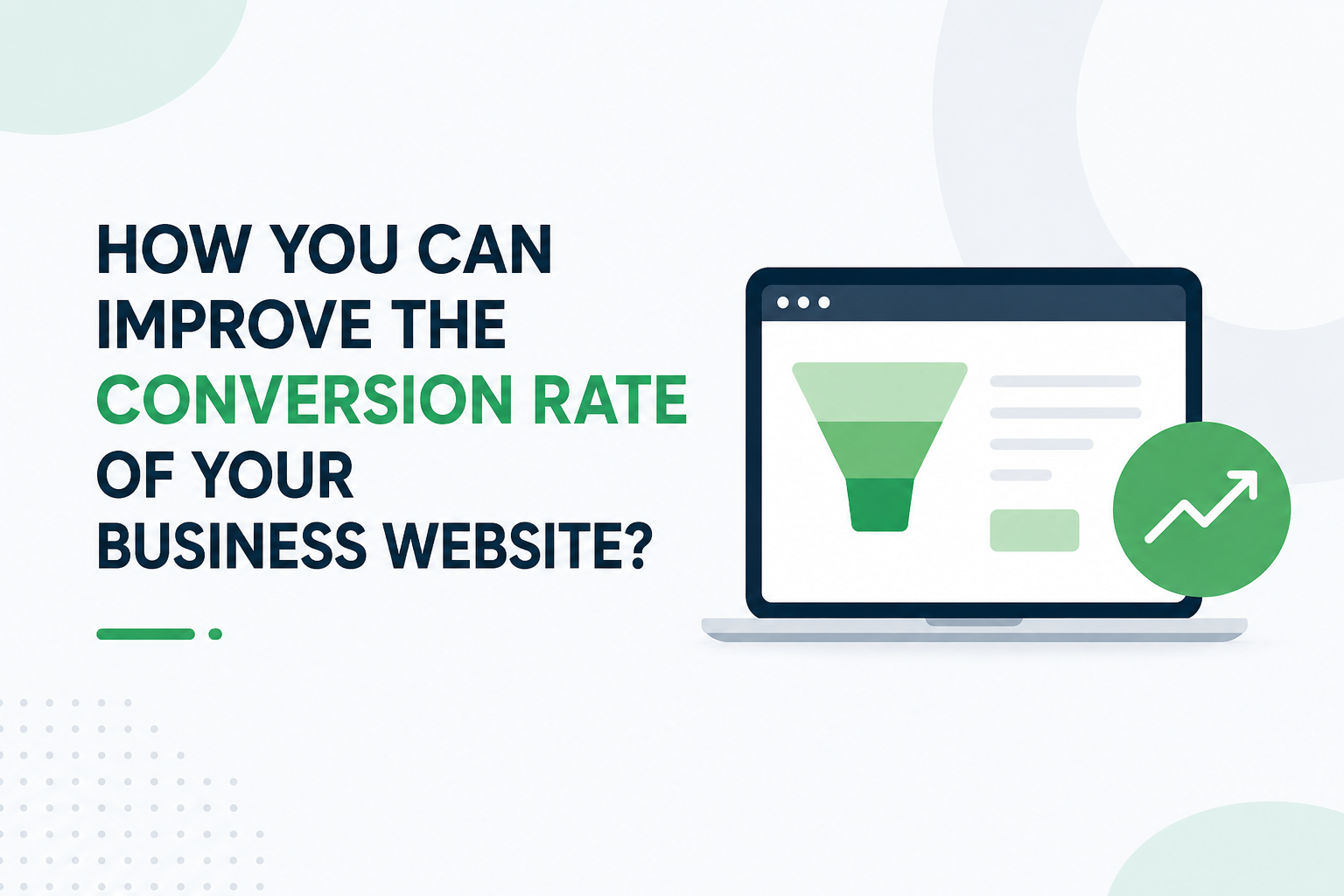
How you can improve the conversion rate of your business website ?
Getting visitors to your business website is only the first step. The real challenge is getting those visitors to take action, whether that means submitting an enquiry form, calling your business, booking a consultation, requesting a quote, or making a purchase.
Improving your website conversion rate means making it easier and more compelling for visitors to take the action that matters to your business. This involves improving your website’s user experience, messaging, page speed, calls to action, trust signals, forms, landing pages, and overall customer journey.
A website can receive thousands of visitors and still generate very few leads if visitors cannot quickly understand what you offer or what they should do next.
What Is Website Conversion Rate?
Website conversion rate is the percentage of website visitors who complete a desired action.
The basic formula is:
Conversion Rate = (Number of Conversions ÷ Number of Visitors) × 100
For example, if 1,000 people visit your website and 30 submit an enquiry form, your conversion rate for that goal is 3%.
However, conversion does not always mean a sale. Depending on your business, a conversion could be:
- Submitting a contact form
- Calling your business
- Requesting a quotation
- Booking an appointment
- Signing up for a newsletter
- Downloading a resource
- Starting a free trial
- Completing an online purchase
Why Is Website Conversion Rate Important?
Conversion rate helps you understand how effectively your website turns existing traffic into business opportunities.
For example, instead of focusing only on getting more visitors, you can ask a more useful question: What can we do to get more value from the visitors we already have?
If your website receives relevant traffic but generates very few enquiries, the problem may not be your traffic. It could be your website’s messaging, design, navigation, trust signals, offer, or conversion process.
How Can You Improve the Conversion Rate of Your Business Website?
1. Make Your Value Proposition Clear
Visitors should understand what your business offers and why they should choose you within a few seconds of landing on your website.
Your homepage or landing page should clearly communicate:
- What you offer
- Who you help
- What problem you solve
- What makes your business different
- What visitors should do next
A vague headline such as “We Deliver Digital Solutions” does not tell visitors enough.
A more specific message such as “SEO Services That Help Businesses Increase Qualified Organic Traffic” immediately communicates the service and potential benefit.
Your website should focus on the customer’s problem and desired outcome rather than only describing your company.
2. Use Clear and Specific Calls to Action
A call to action, or CTA, tells visitors what to do next.
Examples include:
- Get a Free Quote
- Book a Consultation
- Request a Callback
- Get Started
- Shop Now
- Schedule a Demo
Avoid making visitors search for the next step.
Your primary CTA should be visible on important pages and should match the visitor’s intent. A service page, for example, could use “Request a Free Consultation” rather than a generic “Submit” button.
3. Improve Your Website’s User Experience
A website may look attractive but still perform poorly if visitors struggle to find information.
Review your navigation, page structure, menus, buttons, forms, and content from the perspective of a first-time visitor.
Ask yourself:
- Can visitors easily find your main services?
- Can they understand what you offer?
- Is your contact information easy to find?
- Can users reach important pages within a few clicks?
- Are buttons easy to identify?
- Does the website work properly on mobile devices?
A simple and predictable user experience can remove unnecessary friction from the customer journey.
If your website needs a structural or visual improvement, a professional website redesign service can help identify and address usability and design issues.
4. Make Your Website Mobile-Friendly
A significant portion of website traffic can come from smartphones. A website that works well on a desktop but is difficult to use on mobile can lose potential customers.
Check your website on different screen sizes and pay particular attention to:
- Text readability
- Button size
- Navigation
- Contact forms
- Images
- Page spacing
- Checkout or enquiry processes
Mobile users should be able to understand your offer and complete the desired action without unnecessary zooming, scrolling, or navigation.
5. Improve Page Loading Speed
Slow pages can create friction before visitors even see your content.
Review large images, unnecessary plugins, third-party scripts, hosting performance, caching, and other technical factors that may affect page speed.
Speed optimization should focus on both user experience and the technical performance of the website.
If your website has outdated technology or performance problems, rebuilding the site with a performance-focused structure may be more effective than making small design changes. Techventers provides WordPress website development with a focus on responsive design, SEO-friendly development, performance, and usability.
6. Build Trust Before Asking for the Conversion
People are less likely to contact or buy from a business if they are unsure whether the business is legitimate or capable of delivering what it promises.
Add relevant trust signals throughout the customer journey.
These can include:
- Customer reviews and testimonials
- Case studies
- Client logos
- Relevant certifications
- Business address and contact information
- Clear refund or service policies
- Secure payment information
- Portfolio examples
- Industry experience
Trust signals should be placed close to important conversion points rather than hidden on a separate page.
7. Simplify Your Contact Forms
A long or complicated form can discourage people from completing it.
Only ask for information that you genuinely need at that stage of the customer journey.
For example, a simple service enquiry may initially require only:
- Name
- Email or phone number
- Company, if relevant
- Brief description of the requirement
You can collect additional information later if necessary.
Also make sure your forms provide clear feedback after submission. Users should know whether their enquiry was successfully received and what happens next.
8. Create Dedicated Landing Pages
Sending every advertising or marketing visitor to your homepage is not always the best approach.
A dedicated landing page can be built around a specific service, audience, campaign, or search intent.
For example, an advertising campaign targeting businesses looking for SEO services can direct users to a page specifically focused on SEO rather than a general homepage.
A good landing page should have:
- A clear headline
- A relevant offer
- Supporting benefits
- Trust signals
- Relevant proof
- A strong CTA
- Minimal distractions
9. Match Your Content With Search Intent
Conversion optimization starts before the visitor reaches your website.
If someone searches for “how to improve website speed,” they may be looking for educational information. If someone searches for “website development company in India,” they may have stronger commercial intent.
Your content and landing page should match what the visitor is actually trying to accomplish.
This is also where SEO and conversion optimization work together. Better Local SEO, for example, can help a local business attract visitors who are actively searching for relevant products or services in a specific location.
10. Improve Your Product and Service Pages
Your service or product page should answer the questions a potential customer has before taking action.
Depending on your business, include information such as:
- What the service or product includes
- Key benefits
- Who it is suitable for
- How the process works
- Expected deliverables
- Relevant examples
- Frequently asked questions
- Customer reviews
- Clear next steps
For ecommerce businesses, product discovery and product-page experience are especially important. SEO can bring visitors to product pages, but the page itself needs to make the purchase decision easy. Techventers’ eCommerce SEO services focus on areas such as product-page optimization, site structure, usability, and search visibility.
11. Use Analytics to Find Conversion Problems
Do not rely only on assumptions when optimizing your website.
Use analytics and conversion tracking to understand what visitors actually do.
Monitor metrics such as:
- Conversion rate
- Traffic sources
- Landing page performance
- Form submissions
- Phone calls
- Engagement
- Exit and drop-off points
- Device performance
For example, if a landing page receives significant traffic but very few enquiries, investigate that page before simply increasing advertising spend.
12. Test One Important Change at a Time
Conversion rate optimization is an ongoing process.
You can test different versions of important website elements, such as:
- Headlines
- CTA wording
- Button placement
- Images
- Form length
- Offers
- Page layouts
- Trust elements
Do not change everything at once. If several elements change simultaneously, it becomes harder to understand which change affected the result.
Start with the pages and elements that have the biggest potential business impact.
Common Website Conversion Problems
Many websites lose potential customers because of simple problems rather than complicated technical issues.
- Unclear homepage messaging
- Too many competing CTAs
- Slow page loading
- Poor mobile experience
- Long enquiry forms
- Weak trust signals
- Confusing navigation
- Generic or unclear service descriptions
- Missing pricing or important information
- Sending all visitors to the homepage
- No conversion tracking
- Broken links or technical errors
Finding and fixing these issues can often be more useful than simply adding more content to the website.
How SEO and Conversion Rate Optimization Work Together
SEO and conversion rate optimization have different primary objectives, but they work well together.
SEO helps bring relevant visitors to your website.
Conversion optimization helps turn those visitors into leads, customers, or other valuable actions.
For example, ranking for a high-intent keyword can bring qualified visitors to a service page. If that page has a clear offer, strong proof, useful information, and an easy CTA, the probability of generating an enquiry can improve.
This is why website traffic should not be the only SEO success metric. Businesses should also pay attention to what happens after visitors arrive.
A Simple Website Conversion Rate Optimization Checklist
Use this checklist when reviewing your business website:
- Is the main value proposition immediately clear?
- Does every important page have a clear next step?
- Are the primary CTAs easy to find?
- Does the website work properly on mobile?
- Are important pages loading quickly?
- Is the contact form simple?
- Are testimonials or other trust signals visible?
- Does each landing page match its traffic source and search intent?
- Are you tracking enquiries, purchases, calls, and other important conversions?
- Are you regularly reviewing and testing your highest-value pages?
What Is a Good Website Conversion Rate?
There is no single conversion rate that is ideal for every business.
A reasonable conversion rate depends on factors such as industry, traffic source, visitor intent, offer, business model, device, location, and the type of conversion being measured.
Instead of comparing your website with an arbitrary industry benchmark, it is often more useful to establish your current baseline and work toward measurable improvements.
For example, if your website currently converts 2% of qualified visitors, improving that to 2.5% or 3% can have a meaningful effect on your leads without requiring the same percentage increase in traffic.
Frequently Asked Questions
What is conversion rate optimization?
Conversion rate optimization, commonly called CRO, is the process of improving a website or landing page so that a higher percentage of visitors complete a desired action, such as submitting a form, making a purchase, or booking a consultation.
How can I increase my website conversion rate quickly?
Start with high-impact issues such as unclear messaging, weak CTAs, slow pages, complicated forms, poor mobile usability, and a lack of trust signals. Use analytics to identify the pages with the biggest conversion problems and prioritize those first.
Does website design affect conversion rate?
Yes. Design affects how easily visitors understand information, navigate the website, identify important actions, and trust the business. However, good conversion-focused design is not only about visual appearance. It also includes usability, content hierarchy, mobile experience, accessibility, and clear calls to action.
Does SEO improve website conversions?
SEO can contribute to conversions by bringing more relevant visitors to your website. However, rankings and traffic alone do not guarantee conversions. The landing page must also provide a useful experience and make the next step clear.
Should every website have a call to action?
Important commercial pages should generally provide a clear next step. The CTA should match the user’s intent. A product page might use “Buy Now,” while a professional service page may use “Request a Quote” or “Book a Consultation.”
How often should I optimize my website for conversions?
CRO should be treated as an ongoing process rather than a one-time redesign. Review analytics regularly, identify friction points, test meaningful changes, and continue improving pages based on user behavior and business results.
Final Thoughts
Improving the conversion rate of your business website is not about adding more buttons or making the design look more complicated. It is about helping the right visitor understand your offer, trust your business, and take the next step with as little friction as possible.
Start with the basics: clear messaging, strong calls to action, fast and mobile-friendly pages, simple forms, useful content, trust signals, and proper conversion tracking. Then use real user and analytics data to identify what needs improvement.
A well-optimized website should not simply attract visitors. It should help turn relevant visitors into meaningful business opportunities.
If your website is struggling with usability, performance, structure, or design, a professional website development or redesign project can provide a stronger foundation for conversion optimization. Techventers helps businesses build responsive, SEO-friendly websites designed around business goals and user experience.