


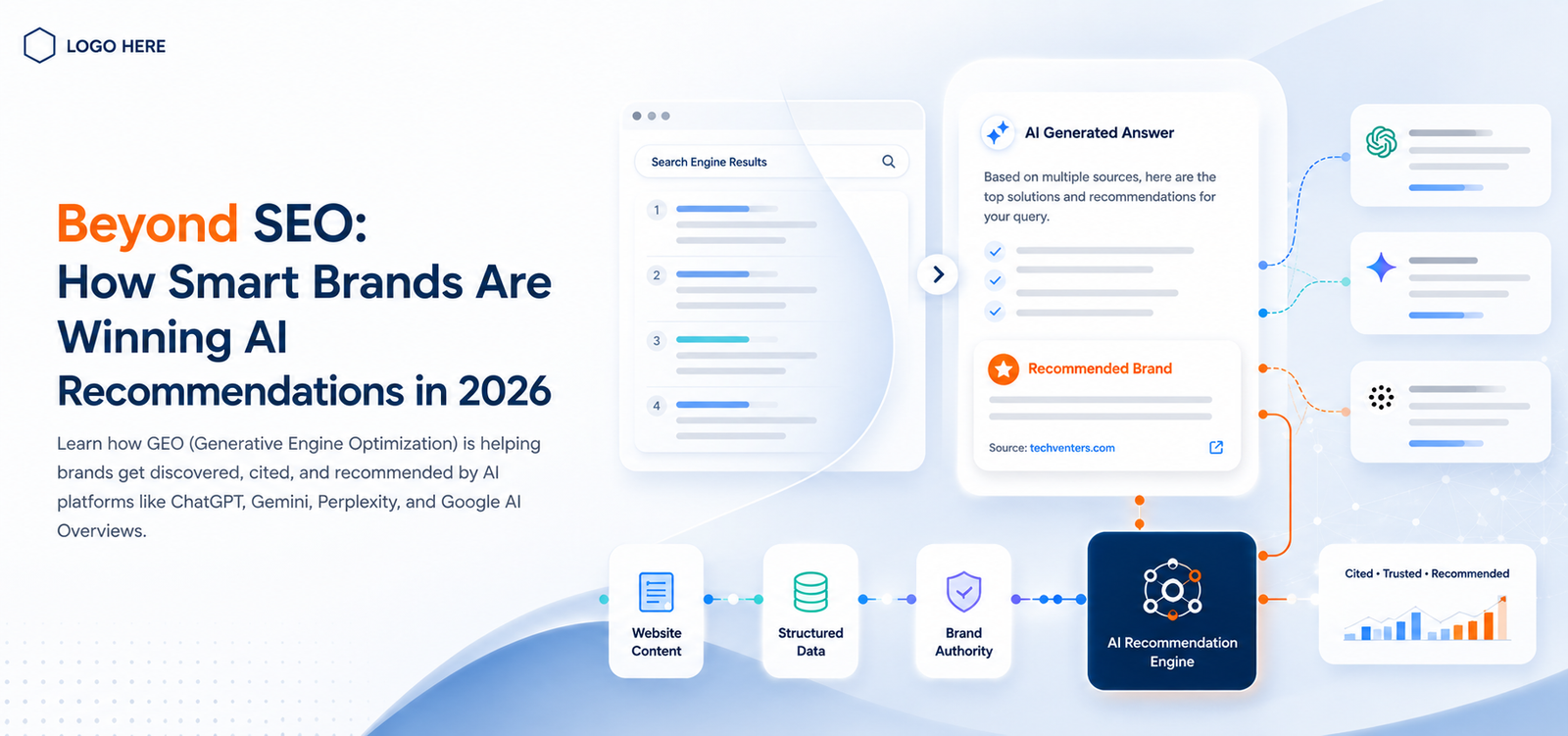
Beyond SEO: How Smart Brands Are Winning AI Recommendations in 2026
For years, digital marketing was built around one simple goal: rank higher on Google. In 2026, that goal still matters, but it is no longer the whole game.
People are increasingly asking AI-powered search tools detailed questions such as “Which SEO agency should I hire?”, “What is the best website platform for my business?” or “Which local service provider is worth considering?” Instead of returning only a list of links, AI-powered search experiences can summarize information and point users toward relevant sources.
This is where AI search optimization and Generative Engine Optimization (GEO) become important.
The good news is that brands do not need to abandon SEO. Google says its existing SEO fundamentals remain relevant to AI features such as AI Overviews and AI Mode. The bigger shift is that brands now need to become easy to discover, understand, trust, and reference across the web. Google’s guidance on optimizing for generative AI features makes the same point: useful, unique, people-first content remains central to visibility in generative search.
What Does AI Recommendation Mean for a Brand?
An AI recommendation happens when an AI-powered search or answer system identifies a business, product, service, website, or source as relevant to a user’s question.
For example, a traditional search might show ten websites for the query “best SEO company in India.” An AI-powered search experience may instead provide a written comparison and mention several companies that appear relevant to the user’s requirements.
That changes the marketing objective.
- Traditional SEO: Improve rankings for relevant searches.
- AI search optimization: Make the brand easy for AI systems to understand and reference.
- GEO: Structure and strengthen a brand’s online presence so it can be surfaced in generative search experiences.
These approaches overlap heavily. In fact, Google explicitly states that there are no special technical requirements or separate markup required just to appear in AI Overviews or AI Mode. Strong technical SEO and helpful content remain the foundation. Google’s documentation on AI features and websites confirms this.
Why SEO Alone Is No Longer the Complete Strategy
SEO is still important, but ranking for a keyword does not automatically make a brand the obvious recommendation.
AI-powered search can work with information from multiple pages and sources. Google’s documentation explains that AI features can use multiple related searches and supporting web pages to develop responses. That means a brand’s visibility can depend on more than one perfectly optimized page.
Think about the difference between these two businesses:
- Business A has one page targeting “digital marketing agency in India” and several generic blog posts.
- Business B has detailed service pages, useful guides, customer reviews, clear company information, industry-specific content, strong internal linking, relevant mentions across the web, and a consistent brand presence.
Even if both businesses compete for similar keywords, Business B gives search systems much more context about who it is, what it does, who it serves, and why it may be trusted.
That is the real meaning of going beyond SEO.
5 Things Smart Brands Are Doing to Win AI Recommendations
1. Building a Recognizable Brand, Not Just Ranking Pages
AI systems need context. A brand becomes easier to understand when its information is consistent across its website and other relevant online sources.
Start by making sure your business name, services, locations, descriptions, contact details, and positioning are consistent wherever your brand appears.
For example, if your website describes your company as an “eCommerce SEO agency” but important third-party profiles describe you as a completely different type of business, you are creating unnecessary ambiguity.
Smart brands therefore work on:
- Consistent business information
- Clear service descriptions
- Strong About and team pages
- Customer reviews and testimonials
- Relevant business listings
- Industry mentions
- Quality backlinks and citations
- Consistent brand positioning
The goal is not to create mentions everywhere. The goal is to create a credible and consistent digital footprint.
2. Creating Content That Answers Real Questions
AI search is particularly useful for conversational and detailed questions. Your content should therefore address the questions your customers actually ask before making a decision.
Instead of publishing another generic article called “Benefits of SEO,” consider creating content such as:
- How long does SEO take for a new website?
- How much does SEO cost for a small business?
- Should a local business invest in SEO or Google Ads?
- What should I check before hiring an SEO agency?
- Why is my website ranking for the wrong keywords?
- How can an eCommerce website improve organic sales?
These topics are useful because they reflect decision-making questions rather than just keyword variations.
Google’s latest guidance also recommends creating content that provides unique value, first-hand experience, useful perspectives, and information that goes beyond what can easily be generated or copied from other websites.
3. Demonstrating First-Hand Experience
This is one of the biggest opportunities for brands in AI search.
AI can summarize common information very efficiently. What is harder to replace is genuine experience.
For example, instead of saying:
“Internal linking is important for SEO.”
A stronger article could explain:
“We noticed that several supporting pages on a client website were receiving impressions but very few clicks. After restructuring internal links around the main service pages, the pages became easier to discover and the site’s topical structure became clearer.”
The second version contains an observation, a situation, an action, and a practical lesson. That gives the content more value than a generic definition.
Use original examples, case studies, experiments, screenshots, customer questions, lessons learned, and expert opinions wherever possible.
4. Strengthening Your Online Reputation
Your website is only one part of your digital identity.
Reviews, industry publications, business directories, social profiles, community discussions, and third-party mentions can all contribute to how people understand your brand.
This is especially important for local businesses.
A restaurant, clinic, salon, lawyer, real estate company, or local service provider should maintain accurate business information and build a genuine review profile. Businesses targeting local customers can also benefit from a structured Local SEO strategy that improves their visibility across geographically relevant searches.
The key word is genuine. Buying fake reviews or creating artificial mentions may produce short-term signals, but it does not create lasting brand trust.
5. Fixing the Technical Foundation
AI search does not make technical SEO obsolete.
If search engines cannot properly crawl, index, understand, or access your website, your content has a limited opportunity to be discovered.
Review these areas regularly:
- Crawlability and indexability
- Robots.txt configuration
- XML sitemap
- Internal linking
- Canonical URLs
- Mobile usability
- Page speed
- Broken links
- Duplicate content
- HTTPS and website security
- Structured data where appropriate
Google’s current guidance specifically recommends ensuring that important content is available in textual form, that pages are crawlable and indexable, and that structured data accurately represents visible content.
If your website needs a technical overhaul, a professional website redesign can also be an opportunity to improve information architecture, usability, content structure, and technical SEO together.
How GEO and SEO Work Together
GEO should not be treated as a replacement for SEO.
A better way to look at it is:
| SEO | GEO / AI Search Optimization |
|---|---|
| Focuses heavily on search visibility and organic rankings | Focuses on visibility within generative answers and recommendations |
| Targets keywords and search intent | Targets questions, entities, context, and conversational intent |
| Optimizes individual pages and websites | Strengthens the wider brand information ecosystem |
| Uses technical SEO and content optimization | Uses those same foundations plus stronger authority and information clarity |
| Measures rankings, clicks, traffic, and conversions | Can additionally monitor brand mentions and visibility across AI search experiences |
The two strategies should work together rather than compete with each other.
Google’s 2026 guidance reinforces this approach. Its generative AI search systems are built on existing Search systems, meaning traditional SEO remains an important foundation for generative search visibility.
A Practical AI Search Optimization Framework for Businesses
If you want to prepare your website for AI recommendations, use this five-step process.
Step 1: Identify Your Most Important Customer Questions
List the questions customers ask before contacting or buying from you.
Look at sales calls, emails, WhatsApp conversations, reviews, support tickets, Google Search Console queries, Reddit discussions, and competitor content.
Step 2: Create the Best Answer on Your Website
Do not simply create a short answer to capture a keyword.
Build a useful resource that explains the topic clearly, includes practical examples, addresses common objections, and provides enough context for someone to make a decision.
Step 3: Connect Related Content
Build topic clusters around your main services.
For example, an eCommerce business could connect content about product SEO, category pages, technical SEO, product schema, internal linking, conversion optimization, and ecommerce content.
If you run an online store, a dedicated eCommerce SEO strategy can help connect product visibility, site structure, content, and user experience.
Step 4: Build Evidence Around Your Claims
If you say your product is faster, demonstrate it. If you say your agency has experience in an industry, show relevant work. If you claim a particular process produces better results, explain how you tested or implemented it.
Evidence makes content more useful and makes your brand easier to evaluate.
Step 5: Monitor More Than Rankings
Rankings are still useful, but they should not be the only KPI.
Also monitor:
- Organic traffic
- Qualified leads
- Conversions
- Branded searches
- Search impressions
- Engagement
- Customer enquiries
- Relevant brand mentions
- Visibility for conversational queries
Google says AI-feature traffic is included in the overall Web performance reporting in Search Console. That makes Search Console and analytics data useful for evaluating the broader impact of AI-driven search visibility.
What Smart Brands Should Stop Doing in 2026
Going beyond SEO does not mean doing more of everything. In many cases, it means removing tactics that add little value.
- Stop publishing dozens of nearly identical AI-generated articles.
- Stop writing solely around keyword variations.
- Stop treating backlinks as a numbers game.
- Stop creating pages that exist only to capture search traffic.
- Stop relying on generic claims without evidence.
- Stop ignoring reviews and brand reputation.
- Stop measuring success only through keyword rankings.
Google’s guidance is clear that using AI to assist with content is not automatically a problem. The issue is whether the resulting content is useful, original, accurate, and created for people. Generating large volumes of low-value content primarily to manipulate search visibility can fall under Google’s scaled content abuse policies.
Example: How a Local Service Brand Can Prepare for AI Search
Imagine a dental clinic wants to become more visible when people ask AI-powered search tools questions such as “Which dentist should I consider for dental implants in Noida?”
A weak strategy would focus only on a page titled “Best Dental Implants in Noida.”
A stronger strategy would include:
- A detailed dental implant service page.
- Clear information about treatments, process, suitability, and aftercare.
- Real patient reviews where appropriate.
- Accurate Google Business Profile information.
- Location-specific content that genuinely helps patients.
- Information about the dental professionals and their qualifications.
- Useful FAQs answering common patient concerns.
- Consistent business information across relevant directories.
- Technical SEO and strong internal linking.
- Useful educational content covering related dental topics.
No one can guarantee that an AI system will recommend the clinic. But this strategy gives both search engines and potential customers substantially more useful information with which to evaluate the business.
Does GEO Replace Traditional SEO?
No. GEO does not replace traditional SEO.
In 2026, the strongest strategy is to combine technical SEO, helpful content, brand building, digital reputation, local or ecommerce optimization where relevant, and content designed around real customer questions.
Google’s own documentation says existing SEO best practices remain relevant to AI features. This means businesses should be careful about anyone selling “AI search optimization” as a completely separate system that makes normal SEO unnecessary.
The better approach is to strengthen the foundation you already need for search and make your brand more useful, clear, authoritative, and recognizable.
Frequently Asked Questions
What is Generative Engine Optimization (GEO)?
Generative Engine Optimization is the practice of improving a brand’s online content and digital presence so that it is easier for generative AI and answer engines to understand, evaluate, and potentially reference when answering user questions.
Is SEO still important for AI search in 2026?
Yes. SEO remains important because AI-powered search experiences still rely heavily on searchable, accessible, relevant web content. Google states that its existing SEO best practices remain relevant for AI Overviews and AI Mode.
How can I make my website more visible in AI search?
Start with strong technical SEO, create original and useful content, answer real customer questions, strengthen internal linking, maintain accurate business information, demonstrate expertise, build legitimate brand mentions and reviews, and measure both traffic and conversions.
Does structured data guarantee AI recommendations?
No. Structured data can help search engines understand eligible content, but it does not guarantee rankings, AI citations, or recommendations. Google also states that there is no special schema markup required specifically to appear in AI Overviews or AI Mode.
Does AI-generated content hurt SEO?
Not automatically. Google evaluates content based on quality and usefulness rather than simply whether AI was involved in its creation. However, generating large amounts of low-value content primarily to manipulate search rankings can violate Google’s spam policies.
What is the difference between AEO and GEO?
AEO, or Answer Engine Optimization, generally focuses on making content suitable for answer-based search experiences. GEO, or Generative Engine Optimization, is a broader term commonly used for optimizing content and brand visibility across generative AI search experiences. The terminology is still evolving, so businesses should focus more on the underlying practices than the label.
Can a small business compete in AI search?
Yes. Small businesses can compete by demonstrating genuine expertise, providing useful local or niche information, maintaining accurate business profiles, collecting authentic customer reviews, publishing first-hand insights, and building a strong reputation within their market.
Conclusion: The Future Belongs to Brands That Are Easy to Trust
The biggest change in search is not simply that AI can generate answers. It is that users are increasingly asking systems to help them understand options and make decisions.
That means brands need to think beyond rankings.
The businesses most prepared for AI recommendations will not necessarily be the ones publishing the most content. They will be the ones that provide the clearest information, demonstrate real expertise, maintain a consistent digital identity, earn genuine trust, and create content that people actually find useful.
SEO gets your brand discoverable. Strong content makes it understandable. Authority makes it credible. And a consistent digital presence gives AI-powered search systems more context to work with.
For businesses, the practical takeaway is simple: do not abandon SEO for GEO. Build a stronger SEO foundation and expand your strategy to include brand authority, useful content, reputation, and AI search visibility.
That is what going beyond SEO really means in 2026.
Sources for factual guidance:
What is GEO (Generative Engine Optimization)?
GEO refers to optimizing your brand, website, and online presence so AI platforms can recognize, trust, and recommend your business in their responses.
Unlike traditional SEO, where the goal is ranking on search engines, GEO focuses on becoming a trusted source for AI systems.
SEO helps your website appear in search results.
GEO helps your brand become the answer itself.
Why Traditional SEO Alone Is Not Enough in 2026
For years, SEO revolved around:
- Keywords
- Backlinks
- Meta tags
- Technical optimization
- Google rankings
While these factors still matter, AI search systems now prioritize:
- Authority
- Context
- Brand trust
- Expertise
- Consistent digital presence
- User engagement signals
- Structured information
AI tools do not simply “rank websites.” They analyze large amounts of information across the internet and recommend brands they consider reliable.
This means your business needs more than rankings — it needs recognition.
How AI Chooses Brands to Recommend
AI systems are becoming smarter at evaluating online credibility. They look for signals such as:
1. Strong Brand Authority
Brands mentioned consistently across websites, blogs, directories, social platforms, and publications gain higher trust.
2. High-Quality Content
AI models prefer content that is:
- Helpful
- Informative
- Human-written
- Structured properly
- Experience-driven
Generic AI-generated spam content is losing value rapidly.
3. Expertise and Niche Relevance
A company that consistently publishes content in one industry is more likely to be recommended for that niche.
For example, if a digital agency regularly shares insights about hospitality marketing, restaurant SEO, and hotel branding, AI will associate that agency with the hospitality sector.
4. User Experience Signals
AI increasingly values:
- Fast websites
- Mobile responsiveness
- Easy navigation
- Clear service pages
- Positive reviews
5. Mentions Across Trusted Platforms
Your brand presence on:
- Clutch
- Google Business Profile
- Medium
- YouTube
- Industry blogs
- News websites
helps AI validate your credibility.
The Rise of AI Search Platforms
Platforms like:
- OpenAI
- Anthropic
- Perplexity AI
are changing how users interact with information online.
Instead of searching “best SEO agency in Noida,” users now ask:
“Recommend a reliable digital marketing company with strong website design and SEO services.”
AI tools provide summarized recommendations instantly.
This reduces dependency on traditional search rankings and increases the importance of authority-driven visibility.
GEO Strategies Brands Must Follow in 2026
1. Build Topic Authority
Instead of publishing random blogs, focus on becoming an expert in a specific niche.
For example:
- Healthcare marketing
- Restaurant branding
- Real estate SEO
- eCommerce advertising
- School admission marketing
Depth matters more than volume.
2. Create Human-Centric Content
AI engines are becoming highly effective at identifying low-quality AI spam.
Brands should focus on:
- Real insights
- Case studies
- Original experiences
- Expert opinions
- Industry trends
Content should solve problems, not just target keywords.
3. Optimize for Conversational Queries
People now search using natural language.
Old SEO:
“best seo agency india”
New AI-driven query:
“Which digital marketing company can help increase local business leads?”
Your content should answer real conversational questions.
4. Strengthen Brand Mentions
AI systems trust brands that appear consistently across multiple trusted platforms.
This includes:
- PR articles
- Guest blogs
- Social media
- Business directories
- Podcasts
- Interviews
- Industry collaborations
Brand visibility beyond your website matters more than ever.
5. Use Structured Data Properly
Schema markup helps AI understand:
- Your services
- Reviews
- Business information
- Products
- FAQs
- Articles
Proper structured data improves discoverability across search and AI platforms.
6. Invest in Thought Leadership
Founders and business leaders who actively share industry insights build stronger authority.
LinkedIn articles, webinars, interviews, and educational content can significantly improve AI trust signals.
People trust experts. AI follows those trust patterns.
GEO + SEO = The Winning Combination
The future is not about replacing SEO.
It is about combining SEO with GEO.
The strongest brands in 2026 will:
- Rank on Google
- Appear in AI recommendations
- Build recognizable authority
- Create valuable content ecosystems
- Become trusted industry voices
SEO brings traffic.
GEO builds influence.
Together, they create long-term digital dominance.
Common Mistakes Brands Must Avoid
Publishing Low-Quality AI Content
Mass-producing shallow blogs can damage credibility.
Ignoring Brand Building
SEO without branding is becoming weaker in AI-driven search.
Focusing Only on Rankings
Visibility now extends beyond search engines.
Weak Website Experience
Slow, outdated websites reduce trust signals.
No Multi-Platform Presence
Brands invisible outside their own website struggle in AI ecosystems.
What Businesses Should Prioritize Right Now
To prepare for the AI-first future, brands should focus on:
- Content quality over quantity
- Industry-specific authority
- Strong website UX
- Reputation management
- Multi-platform visibility
- Conversational content strategies
- Consistent branding
- Video and visual content
- Expertise-driven publishing
The brands that adapt early will dominate the next phase of digital marketing.
Final Thoughts
The digital landscape is evolving faster than ever. Search engines are no longer the only gatekeepers of online visibility. AI platforms are becoming the new recommendation engines for consumers worldwide.
In this new era, brands must think beyond rankings.
The future belongs to businesses that:
- Build trust
- Share expertise
- Create valuable content
- Maintain strong online authority
- Optimize for both humans and AI systems
SEO opened the door to digital visibility.
GEO is opening the door to AI-driven brand discovery.
And in 2026, the brands that master both will lead the market.