

How to Rank Your Business in ChatGPT & AI Search Results (2026 Guide)
People are changing the way they search for businesses. Instead of typing a few keywords into Google and opening several websites, they can now ask ChatGPT and other AI-powered search tools questions such as “What is the best SEO company in Noida?” or “Which digital marketing agency should I hire for my small business?”
This creates a new opportunity for businesses: being discovered inside AI-generated answers, recommendations, and citations.
But ranking in ChatGPT or AI search is not the same as trying to rank for a single Google keyword. There is no guaranteed position, secret AI-search markup, or single “GEO trick” that automatically gets a business recommended.
Instead, businesses need a strong digital presence that makes their company easy to discover, understand, verify, and trust.
In this guide, you will learn how to rank your business in ChatGPT and AI search results, what actually matters in 2026, and how to combine traditional SEO with Generative Engine Optimization (GEO).
What Does It Mean to Rank in ChatGPT and AI Search?
When people talk about “ranking in ChatGPT,” they usually mean getting their business website, brand, products, services, or other online information surfaced when an AI-powered search system answers a user’s question.
For example, a user might ask:
- “What are the best SEO companies in India?”
- “Which local SEO agency can help a business in Lucknow?”
- “What should I look for when choosing an ecommerce SEO company?”
- “Recommend some digital marketing agencies for a small business.”
Depending on the search experience and query, an AI system may use information from websites and other online sources to create an answer. ChatGPT’s official documentation states that ChatGPT Search can search the web, provide links to relevant sources, and rank search results using multiple factors. OpenAI also states that top placement cannot be guaranteed and that websites need to allow OAI-Searchbot to crawl them to be eligible for inclusion. OpenAI’s ChatGPT Search documentation explains the current process.
So, the goal should not simply be “get ChatGPT to mention my company.” The better goal is to build a business that AI systems can confidently understand and associate with the products, services, locations, and expertise that matter to your customers.
Can SEO Help You Rank in ChatGPT?
Yes, traditional SEO still matters.
AI search does not make SEO obsolete. In fact, strong technical SEO, useful content, relevant pages, internal linking, authoritative references, and a trustworthy website provide the foundation for AI visibility.
Google’s guidance is particularly clear on this point. Google says its existing SEO best practices remain relevant to AI features such as AI Overviews and AI Mode, and there are no special technical requirements that guarantee inclusion in those experiences. Google Search Central’s guidance on AI features recommends continuing to focus on fundamental SEO practices.
This means you should not create a completely separate website strategy for AI search. Instead, strengthen your existing SEO strategy while making your content clearer, more useful, more authoritative, and easier for machines and people to understand.
How to Rank Your Business in ChatGPT & AI Search Results
1. Build a Strong SEO Foundation
Before thinking about GEO or AI search, make sure search engines can properly access and understand your website.
Start with the basics:
- Make important pages crawlable and indexable.
- Use descriptive page titles and headings.
- Create logical website architecture.
- Use clean, descriptive URLs.
- Fix broken links and unnecessary redirects.
- Make the website mobile-friendly.
- Improve page speed and Core Web Vitals where appropriate.
- Use canonical URLs correctly.
- Maintain an XML sitemap.
- Use HTTPS.
- Build a useful internal linking structure.
A technically weak website gives both traditional search engines and AI-driven discovery systems less useful information to work with.
If your existing website has technical problems, consider reviewing your overall SEO and digital marketing strategy with Techventers before focusing heavily on AI visibility.
2. Make Your Business Information Extremely Clear
AI systems need to understand what your business actually does.
Do not make visitors or search systems guess.
Your website should clearly communicate:
- What your company does
- Which products or services you provide
- Who you serve
- Where you operate
- Which industries you specialize in
- What makes your business different
- How customers can contact you
- What evidence supports your expertise
For example, instead of saying:
“We provide innovative digital solutions for modern businesses.”
say something more specific:
“Techventers provides SEO, Local SEO, ecommerce SEO, website development, content marketing, and digital marketing services for businesses in India and international markets.”
The second statement gives users and search systems much more useful context.
3. Create Content That Directly Answers Customer Questions
One of the most practical ways to improve AI search visibility is to publish genuinely useful content around the questions your customers ask.
Do not write an article simply because a keyword has search volume.
Ask what information a potential customer needs before making a decision.
For example, an SEO agency could create content around:
- How much does SEO cost in India?
- How long does SEO take to show results?
- What is Local SEO?
- How does Google Business Profile optimization work?
- What is ecommerce SEO?
- How can a small business compete with large websites?
- How does AI search affect SEO?
- How do you choose an SEO company?
Each article should provide a direct answer first, followed by supporting explanation, examples, limitations, and practical advice.
4. Write Clear, Direct Answers for AI Search
AI systems need to identify useful information from a page. Clear writing helps both humans and machines understand the subject.
For important questions, consider using this structure:
- Give the direct answer.
- Explain why it is true.
- Provide an example.
- Explain exceptions or limitations.
- Give the reader an actionable next step.
For example:
Question: Can a small business rank in AI search results?
Yes. A small business can appear in AI-powered search experiences when its online information is relevant, accessible, trustworthy, and useful for the user’s query. However, there is no guaranteed AI ranking position. The business should focus on strong SEO, useful original content, consistent business information, relevant mentions, reviews where appropriate, and a technically accessible website.
This type of answer is much more useful than filling a page with repeated variations of the same keyword.
5. Build Topic Authority Instead of Publishing Random Articles
Publishing one article about SEO does not automatically make a company an authority on SEO.
A better approach is to build a group of related resources around important topics.
For example, a business offering SEO services could build a topic cluster like this:
- SEO fundamentals
- Technical SEO
- Local SEO
- Ecommerce SEO
- Keyword research
- On-page SEO
- Link building
- Content strategy
- AI search optimization
- SEO reporting
These pages can then be connected through relevant internal links.
Techventers already has dedicated resources covering areas such as Local SEO and ecommerce SEO. Connecting related resources logically can help users navigate the site while providing clearer topical context.
6. Demonstrate First-Hand Experience
AI-generated content has made generic information easy to produce. As a result, businesses need to give readers something more valuable than information they could find everywhere else.
Include genuine experience wherever possible.
For example:
- Explain how you solved a real SEO problem.
- Show before-and-after examples when you have permission.
- Discuss lessons from actual campaigns.
- Explain why a particular strategy worked or failed.
- Share original processes and checklists.
- Use screenshots, data, or examples when appropriate.
- Explain industry-specific challenges.
A generic article saying “SEO is important for businesses” adds little value.
An article explaining how a business recovered organic visibility after a technical issue, including the investigation process and lessons learned, is much more useful.
Google’s current guidance also emphasizes valuable, unique content and warns against producing large amounts of low-value content simply to manipulate search visibility. Google’s guidance on generative AI content is a useful reference for publishers.
7. Strengthen Your Brand’s Presence Across the Web
Your website is important, but it is not the only source of information about your business.
A strong digital footprint can include:
- Your official website
- Business directories
- Industry publications
- Relevant third-party websites
- Customer reviews
- Professional profiles
- Social media profiles
- Local business listings
- Interviews and expert contributions
- Relevant backlinks and brand mentions
The important point is quality and consistency.
Do not try to create hundreds of artificial mentions simply because someone calls them “GEO backlinks.” Google specifically warns against pursuing inauthentic mentions, while its generative AI guidance emphasizes high-quality content and established search-quality principles. Google’s generative AI search optimization guide provides more detail.
8. Keep Business Information Consistent
Suppose your website says your company operates in Noida, your business profile says Delhi, and a directory lists an old phone number.
That creates unnecessary confusion.
Review important business information regularly, including:
- Business name
- Address
- Phone number
- Website URL
- Opening hours
- Service areas
- Services offered
- Business descriptions
For businesses serving specific locations, Local SEO becomes especially important because customers often search using location-based phrases such as “SEO company near me,” “SEO agency in Noida,” or “digital marketing company in Lucknow.”
9. Optimize Your Google Business Profile and Local Presence
If your business serves a local market, do not focus only on website rankings.
Maintain an accurate Google Business Profile and make sure your website, business profile, and other important listings provide consistent information.
Useful local SEO activities include:
- Keeping business information accurate
- Selecting appropriate business categories
- Adding relevant services
- Publishing useful updates where appropriate
- Collecting genuine customer reviews
- Responding professionally to reviews
- Adding accurate location information
- Creating useful location-specific website content
This matters because AI search can also use location context when answering local queries. OpenAI’s documentation notes that ChatGPT Search can use location information to provide more relevant local results. Read OpenAI’s current ChatGPT Search guidance.
10. Use Structured Data, But Don’t Treat It as a Magic GEO Trick
Structured data can help search engines understand certain types of information on your website and can make pages eligible for supported rich search features.
Depending on the website, relevant structured data may include:
- Organization
- LocalBusiness
- Product
- Article
- Breadcrumb
- Review-related markup where eligible and compliant
However, structured data should describe information that is actually visible and accurate on the page.
It should not be treated as a hidden mechanism for forcing an AI system to recommend your business.
Google’s current guidance specifically says there is no special schema markup required for generative AI search visibility. Structured data remains useful as part of normal SEO when implemented correctly. Google Search Central’s AI optimization guidance explains this distinction.
11. Make Your Website Easy to Crawl
One of the most basic requirements for online visibility is accessibility.
For ChatGPT Search, OpenAI says websites should allow OAI-Searchbot to crawl their content and ensure their hosting environment or CDN permits traffic from OpenAI’s published searchbot IP addresses.
For Google, the fundamentals remain similar: important content needs to be accessible to Googlebot, pages should return successful HTTP responses, and content needs to be indexable. Google’s guidance for AI search confirms that these technical requirements continue to matter. Google’s guidance for AI search visibility covers these requirements.
Therefore, check your:
- robots.txt file
- Meta robots directives
- XML sitemap
- Canonical tags
- HTTP status codes
- Internal links
- JavaScript-dependent content
- Website security and accessibility
12. Improve Your Internal Linking
Internal links are useful for more than passing authority between pages.
They help users and search systems understand how different pages on your website are connected.
For example, an article about AI search could naturally link to:
- Your main SEO service page
- Your Local SEO page
- Your ecommerce SEO page
- A related AI and SEO article
- A website development page
Techventers also has an article explaining how AI is changing SEO in 2026. Linking related articles together creates a more useful content journey for readers.
13. Make Your Service Pages More Informative
Many businesses spend time optimizing blog posts while their most commercially important pages remain thin.
Your service pages should clearly explain:
- What the service is
- Who needs it
- What is included
- How your process works
- What problems you solve
- What results customers can reasonably expect
- Which industries you serve
- Frequently asked questions
- How customers can get started
For ecommerce businesses, this becomes even more important because product and category pages need to provide enough useful information for both customers and search systems. A well-structured ecommerce SEO strategy can address product content, category architecture, technical SEO, internal linking, and structured data.
14. Create Comparison and Decision-Making Content
AI search is particularly useful when people are evaluating options.
That makes comparison content valuable when it is genuinely useful and unbiased.
Examples include:
- SEO agency vs. freelancer
- Local SEO vs. traditional SEO
- SEO vs. paid advertising
- WordPress vs. Shopify for ecommerce
- In-house SEO vs. SEO agency
Good comparison content should explain the strengths, weaknesses, costs, limitations, and ideal use cases of each option.
Avoid writing comparison pages that simply declare your own company the winner without providing useful evidence.
15. Earn Genuine Reviews and Mentions
Reviews can help customers evaluate a business, particularly for local and service-based businesses.
Ask real customers for honest feedback and make it easy for them to leave reviews on appropriate platforms.
Do not buy fake reviews or create manufactured testimonials. The objective is to build genuine reputation, not simply increase the number of mentions associated with your brand.
The same principle applies to backlinks and PR. One relevant mention from a respected industry source can be more useful than a large number of low-quality links.
16. Track AI Visibility Instead of Guessing
AI search visibility can be harder to measure than traditional keyword rankings.
Instead of checking one prompt once and assuming your strategy worked, create a repeatable monitoring process.
Build a list of questions that potential customers might ask.
For example:
- “Best SEO company in Noida”
- “Best SEO agency in India for small businesses”
- “Who provides Local SEO services in India?”
- “Which agency can help with ecommerce SEO?”
- “How much does SEO cost in India?”
Then monitor whether your brand is:
- Mentioned
- Recommended
- Cited
- Associated with the correct services
- Associated with the correct locations
- Described accurately
Do not treat a single AI response as a permanent ranking position. AI responses can change based on the query, available web information, location, freshness, and other factors.
SEO vs. GEO: What’s the Difference?
| Traditional SEO | GEO / AI Search Optimization |
|---|---|
| Focuses heavily on search engine visibility | Focuses on visibility in AI-generated answers and recommendations |
| Targets keywords and search intent | Targets questions, entities, topics, and decision-making contexts |
| Measures rankings, traffic, and conversions | May also monitor mentions, citations, recommendations, and AI visibility |
| Relies on strong website and content foundations | Still depends heavily on strong website and content foundations |
| Optimizes pages for search users | Optimizes the broader information ecosystem around a brand |
The important takeaway is that GEO should complement SEO, not replace it.
A Practical 90-Day AI Search Optimization Plan
Days 1-30: Fix the Foundation
- Audit technical SEO.
- Check indexing and crawling.
- Review robots.txt and XML sitemap.
- Improve important service pages.
- Review business information for consistency.
- Set up or improve Google Business Profile where relevant.
- Identify your most important customer questions.
Days 31-60: Build Useful Content
- Create detailed question-based content.
- Build topic clusters around core services.
- Add practical examples and first-hand insights.
- Improve internal linking.
- Add useful FAQs to important pages.
- Improve author and business credibility signals.
Days 61-90: Build Authority and Measure Visibility
- Earn relevant backlinks and mentions.
- Publish original insights and case studies.
- Improve reviews and local citations.
- Monitor important AI-search questions.
- Compare your visibility with competitors.
- Update outdated content.
- Improve pages that receive impressions but weak engagement or conversions.
Common Mistakes to Avoid When Optimizing for AI Search
Creating Hundreds of AI-Generated Articles
More content does not automatically mean more visibility. Publishing large volumes of generic pages can create a website with little unique value.
Keyword Stuffing
Repeating phrases such as “best SEO company,” “best SEO agency,” and “SEO company India” throughout every paragraph does not create better content.
Creating Fake Brand Mentions
Do not build artificial mentions simply because you believe an AI system will notice them.
Ignoring Technical SEO
A website cannot benefit fully from excellent content if important pages are blocked, broken, poorly structured, or difficult to crawl.
Writing Only for AI
Google’s current guidance makes an important point: there is no need to write content in a special format solely for generative AI systems. Content should primarily serve users. Google’s AI search optimization guidance recommends focusing on valuable, unique content rather than trying to manipulate AI systems.
Expecting Guaranteed ChatGPT Rankings
No legitimate SEO or GEO professional can guarantee that ChatGPT will recommend a particular business for a particular query.
OpenAI explicitly states that search placement is not guaranteed.
Can a Small Business Rank in ChatGPT Search?
Yes. A small business does not necessarily need to be a multinational brand to become visible in AI search.
A smaller company can improve its chances by becoming highly relevant for a specific market, service, audience, or location.
For example, instead of trying to be known for the extremely broad topic “digital marketing,” a company could establish strong topical relevance around “Local SEO for businesses in Noida” or “ecommerce SEO for Indian online stores.”
The strategy is to build genuine expertise and visibility around the areas where the business actually competes.
How Techventers Can Help With SEO and AI Search Visibility
AI search optimization is not a replacement for SEO. It is an extension of the broader goal of making a business easier to discover and trust online.
At Techventers, the approach can include technical SEO, content strategy, Local SEO, ecommerce SEO, website optimization, internal linking, and broader digital visibility. The exact strategy should depend on the business, competition, audience, location, and current website performance.
For businesses that need a stronger digital foundation, Techventers provides SEO and digital marketing services designed around online visibility, traffic, leads, and long-term growth.
For local businesses, the Local SEO service focuses on improving visibility for geographically relevant searches and strengthening local online presence.
For online stores, ecommerce SEO services focus on product visibility, category pages, site structure, content, and technical optimization.
Frequently Asked Questions
How do I get my business listed in ChatGPT search results?
There is no manual form that guarantees your business will appear in ChatGPT Search. OpenAI states that websites should allow OAI-Searchbot to crawl their content and that search ranking depends on multiple factors. Build a technically accessible website, publish useful information, maintain accurate business details, and build genuine authority across the web.
Does ChatGPT ranking require a special GEO technique?
No single GEO technique guarantees visibility. Strong SEO fundamentals, useful original content, clear business information, technical accessibility, and genuine authority are more important than a single optimization trick.
Is SEO still important for AI search in 2026?
Yes. Google states that existing SEO best practices remain relevant to AI features such as AI Overviews and AI Mode. Technical accessibility, useful content, clear website structure, and search intent remain important foundations.
Does structured data help businesses rank in ChatGPT?
Structured data can help search engines understand specific types of content, but it should not be treated as a guaranteed ChatGPT ranking factor. Google states that there is no special schema markup required for generative AI search.
How long does it take to appear in AI search results?
There is no fixed timeline. It depends on factors such as website accessibility, content quality, authority, competition, freshness, and how the AI search system retrieves and evaluates information. AI visibility should be treated as an ongoing SEO and brand-building effort rather than a one-time submission.
Should I create separate content for Google and ChatGPT?
Usually, no. Create genuinely useful content for people first. The same high-quality content can potentially support traditional search and AI-powered search. You may improve formatting and clarity, but you do not need to create duplicate versions of every article for different search engines.
Can local businesses appear in AI search recommendations?
Yes. Local businesses can be surfaced for location-specific questions. Accurate business information, Local SEO, reviews, relevant local content, and a strong online presence can help search systems understand the business and its service area.
Can I guarantee that ChatGPT will recommend my business?
No. ChatGPT Search results are generated dynamically and ranking is not guaranteed. Any agency promising guaranteed ChatGPT recommendations should be treated cautiously.
Conclusion
How to rank your business in ChatGPT and AI search results is not a question with one secret optimization technique.
The strongest strategy is to build a business that is easy for both people and search systems to understand and trust.
That means starting with technical SEO, creating genuinely useful content, answering customer questions directly, building topical authority, keeping business information consistent, improving local visibility where relevant, earning genuine mentions and reviews, and continuously measuring how your brand appears across search experiences.
AI search is changing how people discover businesses, but the fundamentals remain familiar. Businesses that invest in useful information, strong websites, real expertise, and credible online presence will be in a much better position as search continues to evolve.
The goal is not simply to rank first for a keyword.
The goal is to become a business that search engines and AI systems can understand, users can trust, and potential customers can confidently choose.
Primary Keyword
how to rank your business in ChatGPT and AI search results
Secondary Keywords
ChatGPT SEO, AI search optimization, GEO SEO, Generative Engine Optimization, how to rank in ChatGPT, AI search results, AI SEO strategy, ChatGPT business visibility, AI search optimization for businesses, rank in AI search, SEO for AI search, AI search marketing
SEO Title
How to Rank Your Business in ChatGPT & AI Search Results (2026 Guide)
Meta Description
Learn how to rank your business in ChatGPT and AI search results with practical SEO, content, brand authority, local SEO, and GEO strategies for 2026.
URL Slug
how-to-rank-business-chatgpt-ai-search-results
Suggested Featured Image Concept
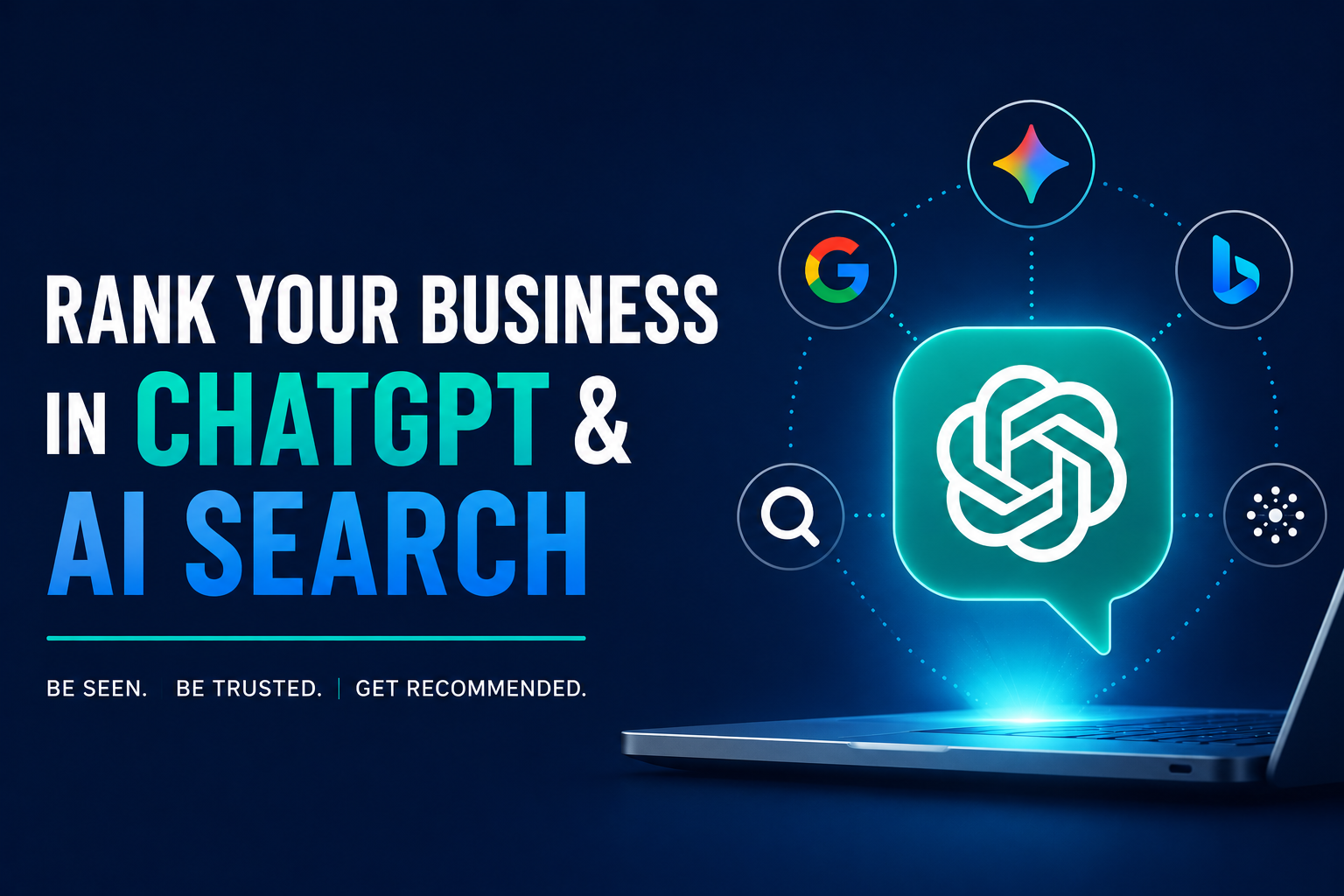
A clean, minimal 16:9 banner showing a business website moving from traditional Google search into an AI-powered answer interface. Include subtle visual elements for SEO, ChatGPT, AI Search, citations, and brand visibility. Keep the design professional and uncluttered, with the main headline: “How to Rank Your Business in ChatGPT & AI Search”.
What is AI Search?
AI search uses large language models (LLMs) to understand user intent and provide direct, conversational answers instead of simply displaying a list of web pages.
Some of the most popular AI search platforms include:
- ChatGPT Search
- Google AI Overviews
- Google AI Mode
- Gemini
- Perplexity AI
- Microsoft Bing Copilot
Unlike traditional search engines, these platforms analyse multiple trusted sources before generating a response. That’s why building authority and credibility has become more important than ever.
How AI Search Chooses Websites
Although every AI platform works differently, most of them evaluate similar quality signals before recommending a website.
1. Publish Helpful, Original Content
Create content that genuinely solves users’ problems. Detailed guides, tutorials, case studies, and expert insights are more likely to be referenced by AI search tools than thin or promotional content.
2. Build Topical Authority
Instead of publishing random blogs, focus on a specific niche. For example, if your business specialises in digital marketing, create comprehensive content around SEO, Google Ads, website development, content marketing, and AI SEO.
When your website consistently covers related topics, search engines recognise your expertise.
3. Optimise for E-E-A-T
Google emphasises Experience, Expertise, Authoritativeness, and Trustworthiness (E-E-A-T), and these principles also influence AI-generated answers.
Strengthen your credibility by:
- Adding author profiles
- Including real client case studies
- Displaying testimonials
- Publishing accurate and up-to-date information
- Citing reliable sources where appropriate
4. Improve Technical SEO
Even the best content can struggle if your website has technical issues.
Ensure your website:
- Loads quickly
- Is mobile-friendly
- Uses HTTPS
- Has clean URLs
- Includes proper heading structure
- Implements Schema Markup
A technically sound website is easier for both search engines and AI systems to understand.
5. Answer Conversational Questions
People interact with AI differently than they do with traditional search engines. They ask complete questions such as:
- How can I improve my local SEO?
- Which digital marketing strategy is best for small businesses?
- How do I rank in ChatGPT?
Create FAQ sections and write content that directly answers these natural language queries.
Traditional SEO vs AI SEO
| Traditional SEO | AI SEO |
|---|---|
| Focuses on keyword rankings | Focuses on helpful, authoritative answers |
| Optimises for search results | Optimises for AI-generated recommendations |
| Prioritises backlinks | Values authority, brand mentions, and expertise |
| Targets search engines | Targets both users and AI assistants |
The future of SEO isn’t replacing traditional optimisation—it’s expanding it to include AI-powered discovery. Businesses that combine strong SEO fundamentals with AI Search Optimisation will be better positioned to increase visibility across Google Search, ChatGPT, Gemini, Perplexity AI, and other AI-powered search platforms.
Final Thoughts
Ranking your business in ChatGPT and other AI search platforms isn’t about finding shortcuts. It’s about creating valuable content, improving your website’s technical performance, and building a trusted online presence.
Businesses that invest in AI Search Optimization today will be better positioned as AI continues to influence how customers discover products and services.
If you’re ready to improve your visibility across ChatGPT, Google AI Overviews, Gemini, and Perplexity AI, the team at Techventers can help. Our experts specialise in SEO, technical optimisation, content strategy, and website development to ensure your business is prepared for the future of search.
Ready to grow your online visibility? Contact Techventers today for a FREE SEO & AI Visibility Audit and discover how your business can stand out in the age of AI search.