

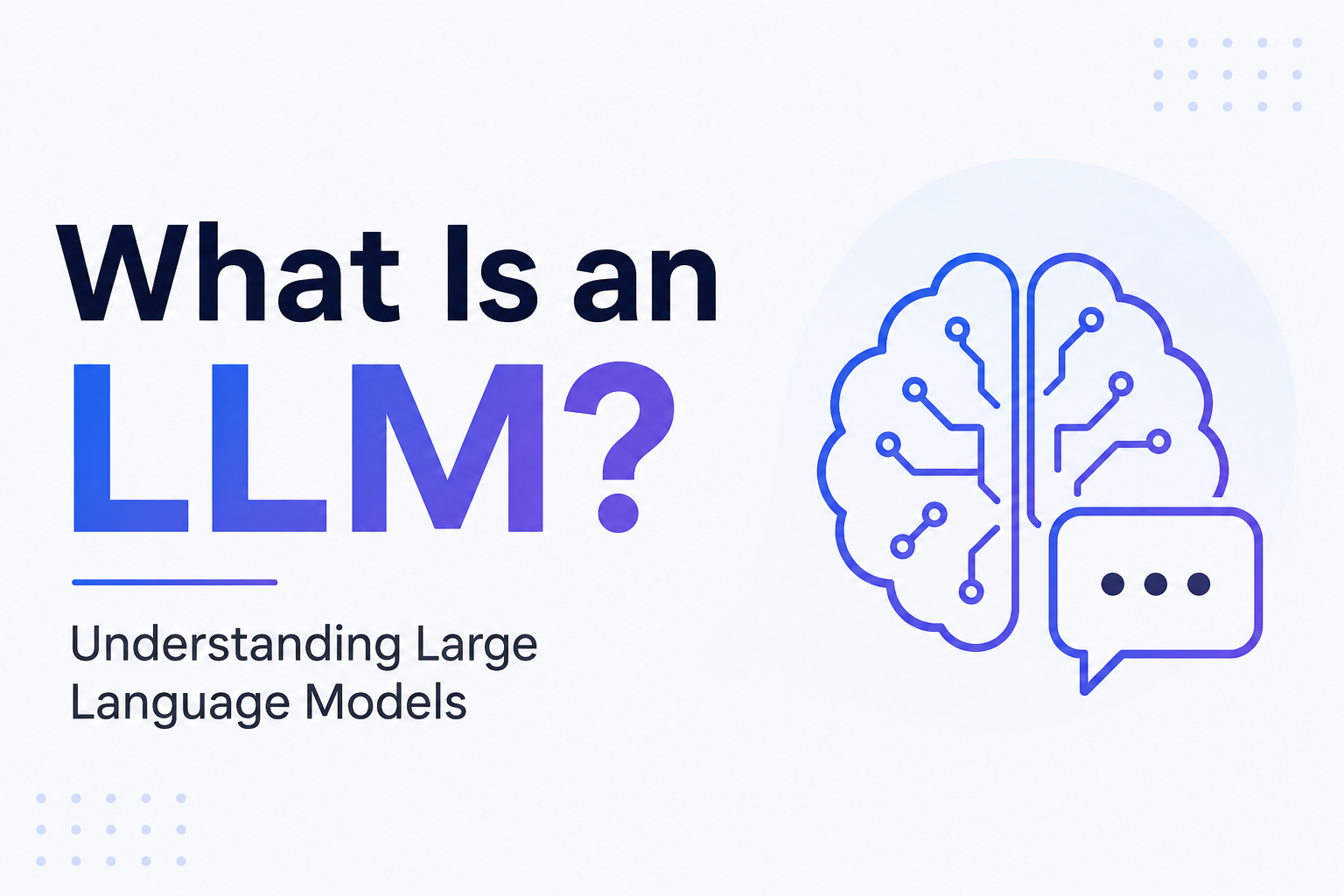
What Is an LLM?
LLM stands for Large Language Model. In simple terms, an LLM is an artificial intelligence system trained on a very large amount of text and data. It learns patterns in language and can use those patterns to understand prompts and generate human-like responses.
LLMs are behind many modern AI applications, including tools such as ChatGPT and other AI-powered assistants. They can help users answer questions, create content, summarize information, translate languages, generate ideas, write code, and perform many other language-related tasks.
How Does an LLM Work?
An LLM does not think exactly like a human. Instead, it processes the information in a prompt, identifies patterns learned during training, considers the context, and generates a relevant response.
For example, if you ask an AI assistant, “What are the benefits of SEO for a business?”, the LLM analyzes the question and generates a response based on the language patterns and information it has learned.
The process can be simplified into four basic steps:
- Training: The model learns from large amounts of text and other data.
- Pattern recognition: It learns patterns in language, grammar, concepts, and relationships between words.
- Context understanding: It analyzes the context of a user’s prompt.
- Response generation: It generates a relevant response based on the prompt and learned patterns.
Why Are LLMs Important for Digital Marketing?
LLMs are changing how people discover information online. Traditionally, users searched Google using keywords such as “best SEO agency in India” or “SEO services for small businesses.”
With AI-powered search and assistants, users can ask much more conversational questions, such as:
“Can you recommend a reliable SEO agency for a small business in India?”
This shift is important for businesses because visibility is no longer limited to traditional search engine results. Brands also need to think about how their content, expertise, and online presence can be understood and referenced by AI-powered systems.
This is one reason why businesses are paying more attention to AI search, Generative Engine Optimization (GEO), and LLM Optimization (LLMO).
LLMs and SEO: What Is Changing?
Traditional SEO services focus on improving a website’s visibility in search engines by working on areas such as content, technical SEO, keywords, internal linking, backlinks, and user experience.
LLM-powered search introduces another layer of visibility. Instead of only asking, “Where does my website rank?”, businesses may also need to ask:
- Is my brand being mentioned in AI-generated answers?
- Does AI understand what my business does?
- Is my website providing clear and useful information?
- Does my online presence demonstrate expertise and credibility?
- Can AI systems easily understand and connect information about my business?
This does not mean traditional SEO is becoming irrelevant. Instead, strong SEO provides an important foundation for building online visibility across both traditional search and emerging AI-powered discovery platforms.
How Can Businesses Prepare for AI Search?
Businesses can start by creating content that is useful not only for search engines but also for real people and AI systems.
1. Create Helpful, Clear Content
Answer the questions your target audience actually asks. Use simple language, clear headings, short paragraphs, examples, and specific information.
2. Demonstrate Expertise
Content should clearly communicate your experience, knowledge, and understanding of the subject. Case studies, original insights, expert opinions, author information, and trustworthy sources can help strengthen credibility.
3. Build a Strong Website Structure
A well-organized website makes it easier for users and search engines to understand your business. Relevant internal links can connect related topics and important service pages.
For example, businesses looking to improve their local visibility can explore
Local SEO services,
while online stores can benefit from specialized
eCommerce SEO services.
4. Keep Content Updated
AI search and digital marketing continue to evolve. Updating important pages and articles helps keep information accurate, relevant, and useful.
5. Build Brand Authority Across the Web
Your website is only one part of your online presence. Brand mentions, relevant backlinks, reviews, business profiles, industry publications, and other trusted sources can contribute to how your business is understood online.
What Can LLMs Do in Digital Marketing?
LLMs can support marketers across many areas of digital marketing, including:
- Blog and content creation
- Social media content ideas
- Product descriptions
- Email marketing copy
- Keyword and topic research
- Content briefs
- Customer support
- Content summarization
- Translation
- Marketing research and analysis
- AI-powered search optimization
However, AI-generated content still needs human review. Accuracy, originality, expertise, and usefulness remain important when creating content for a business website.
LLM vs. Traditional Search
Traditional search engines generally return a list of webpages for a user’s query. LLM-powered systems can interpret a conversational question and generate a direct response using information available to the system.
For digital marketers, this creates a broader definition of online visibility.
Instead of focusing only on ranking a webpage, businesses should also focus on becoming a trusted source of information.
This is particularly relevant for businesses investing in
enterprise SEO,
local search, eCommerce SEO, and broader digital marketing strategies.
Why LLMs Matter for the Future of Search
The way people search for information is changing. Instead of entering short keywords, users are increasingly comfortable asking detailed, conversational questions.
This means businesses need to think beyond rankings and focus on the overall quality and authority of their online presence.
A strong combination of technical SEO, helpful content, clear website structure, internal linking, brand authority, and a good user experience can help businesses build a stronger foundation for the changing search landscape.
If your website also needs a stronger technical and user experience foundation, professional
website development
can play an important role in creating a fast, responsive, and SEO-friendly website.
Frequently Asked Questions About LLMs
What does LLM stand for?
LLM stands for Large Language Model. It is an AI model trained on large amounts of data to understand and generate human-like language.
Is ChatGPT an LLM?
ChatGPT is an AI application that uses large language models to understand prompts and generate responses.
How are LLMs used in digital marketing?
LLMs can help marketers with content creation, research, customer communication, idea generation, summarization, SEO workflows, and AI search optimization.
What is LLMO?
LLMO generally refers to Large Language Model Optimization. It describes efforts to make information about a brand or business easier for large language models and AI systems to understand and use.
Is LLMO replacing SEO?
No. LLMO and AI search are better viewed as an evolution of search visibility rather than a complete replacement for SEO. Strong technical SEO, useful content, authority, and a well-structured website remain important foundations.
The Future of Search Is Changing
LLMs are becoming an important part of how people interact with information online. For digital marketers, this means the traditional SEO approach is evolving.
Search visibility is no longer only about where your website ranks. It is also about whether your brand becomes part of the answer.
Businesses that start building useful content, strong topical authority, structured websites, and trustworthy online signals can be better prepared for the continued growth of AI-powered search.
Want to improve your website’s organic visibility and prepare for the changing search landscape?
Explore Techventers SEO Services
or
Contact Techventers
to discuss your requirements.